


Where Dragons Still Sleep: Utah’s Smoldering Coal Seam


We thought we were just cruising another dusty dirt road north of western Lake Powell, the kind that feels like the middle of nowhere, somewhere special, when our noses betrayed us first. Dan McGregor, our unofficial trail leader and professional fluid-gauge reader, slowed the old rig to a crawl.
The smell was unmistakable: rotten eggs, sulfur heavy and sticky in the air. We pulled off the narrow track, dust settling behind us like a curtain, and Dan popped the hood. Everything looked normal, yet the odor lingered. That’s when Tara pointed off to the right, where the ground cracked open like a secret waiting to be told.

At first glance it looked like a fracture in the earth, solid rock sliced in two, running hundreds of feet long and a foot or two wide. Susan and Richard Frost, always ready with cameras and curiosity, leaned in. The fissure felt ancient, as though it pierced into the guts of the world itself.
What we smelled wasn’t from the car after all. It was coming from deep below the surface and we'd soon realize that Smoky Mountian was living up to its name.
If you follow Smoky Mountain Road long enough, you may not find dragons but you begin to appreciate why the name stuck. Utah's smoldering Coal Seam allows smoke to rise from the earth here, not from a campfire or wildfire, but from a coal seam fire burning underground. What looks like steam or mist wafting between rocks is actually gas and heat escaping from ancient coal deposits that have been smoldering for hundreds, perhaps thousands, of years.
Geologists aren’t certain exactly how the fire first ignited, it could have been a lightning strike, spontaneous combustion, or some combination of heat and oxygen finding just the right, volatile conditions.
Unlike the dramatic flames of a forest fire, this is a slow, simmering burn. There’s no towering inferno here, just fissures that rumble warmth, sulfur scent, and a reminder that the earth can harbor slow, powerful fires we rarely see.

This stretch of desert is more than just a scenic byway. Smoky Mountain Road, a rugged backroad that threads between Bryce Canyon and Lake Powell, earned its name from these very smoldering seams that occasionally vent smoke to the surface.
We had been down this way years ago, turning off onto Road 343 out of curiosity and being rewarded with expansive views, but no visible smoke. This time, though, the smell was undeniable. Following our noses literally led us to another old spur off the main dirt road, and to a place where the earth seemed alive in a whispering way.
Fire-Breathing Earth, Not Dragons: But Close Enough
“We couldn’t tell where the smell was strongest until we drove closer,” Tara laughed later. “But whatever it was, it definitely wasn’t in the car.” The ground around the fissures hisses in cold weather — you’ll see what looks like steam rising over the rock cracks, ethereal and silent. It’s different from wildfire smoke, more ghostly, as though the mountain were exhaling through centuries-old lungs.
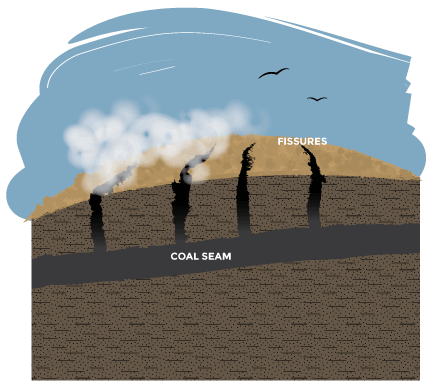
Some locals liken it to a fire-breathing dragon trapped beneath the earth, eerie, marvelous, a little unsettling, and that image stuck with us as we wandered amid the cracks, cameras in hand and minds buzzing. What the Bureau of Land Management and early surveyors tried decades ago only highlighted how stubborn this fire is: efforts to suffocate the burn with dirt and water didn’t stick, and the seams continue their slow combustive dance to this day.
What We Learned on the Road to Utah’s Smoldering Coal Seam
The sulfur smell isn’t from the car, it’s from underground combustion in ancient coal seams.
These fires can burn for ages, popping up smoke where fissures feed them oxygen.
Smoky Mountain Road is remote, rough, and filled with geological surprises if you follow the story of the land.
Make sure to always park downwind when the wind decides to remind you what’s hiding beneath the surface.
We left that day with lingering scents on our clothes and a deeper sense of wonder about what the earth holds just beneath its skin. For travelers, seekers, and storytellers, places like Smoky Mountain offer more than a view, they offer a visceral reminder that the land keeps its own long, fiery rhythms.
How to Get There:
Notes from the Utah Geological Survey: The cracks and fissures atop Smoky Mountain are located approximately 245 miles south of Salt Lake City.From Kanab, drive east on U.S. Highway 89 for approximately 57 miles to Big Water. Turn left (north) onto Ethan Allen Road for 0.3 miles and turn right (east) onto National Park Service (NPS) Road 230. Continue for 12.7 miles and make a slight right to stay on NPS 230. After this junction, NPS 230 is also known as Smoky Mountain Road. Continue for 1 mile and stay left to stay on Smoky Mountain Road (also known as Bureau of Land Management [BLM] Road 300). Stay on Smoky Mountain Road for the next 7.6 miles as it winds up 1,000 feet of elevation to the top of Smoky Mountain. As the road levels out at the top of the climb, continue past the viewpoint pullout for an additional 1.4 miles to an unmarked road on the right. Turn at this unmarked road and continue for 0.6 miles to another junction on the right. Turn at this junction and continue for 0.2 miles to where you will park. Upon exploring the vicinity, you will see the numerous ground fissures. Remember though, if it is smoke you are looking for, then you will need to visit on a very cold day.

Note: NPS 230 and Smoky Mountain Road (BLM 330) are generally impassible during and shortly after wet weather conditions and cross numerous washes that can be subject to flash floods. Please research weather and road conditions before planning a trip. A helpful website that provides road conditions for Grand Staircase-Escalante National Monument. Also, be advised that web-based mapping services as well as paper maps/atlases from various sources tend to disagree as to what names are given to the roads to Smoky Mountain, so please research your route thoroughly before starting your journey.


Comments